The Party of the Revolution
The Communist Party of Cuba (PCC) is the governing political organization of the Cuban state and society — the only legally recognized political party on the island. It was founded on October 3, 1965, when Fidel Castro unified the July 26 Movement, the March 13 Revolutionary Directorate, and the Popular Socialist Party into a single entity.
Cuba's 2019 Constitution defines the PCC as "the superior leading political force of society and the State, which organizes and guides the common efforts toward the high ends of the construction of socialism." Its role in Cuba's political, economic, and social life is decisive.
The party has a hierarchical structure ranging from base committees in factories, schools, and neighborhoods up to the Political Bureau and the Central Committee — the top governing bodies between Party Congresses, held every five years.

Exhibition at a Communist Party of Cuba Congress. Photo: Wikimedia Commons (CC BY-SA)
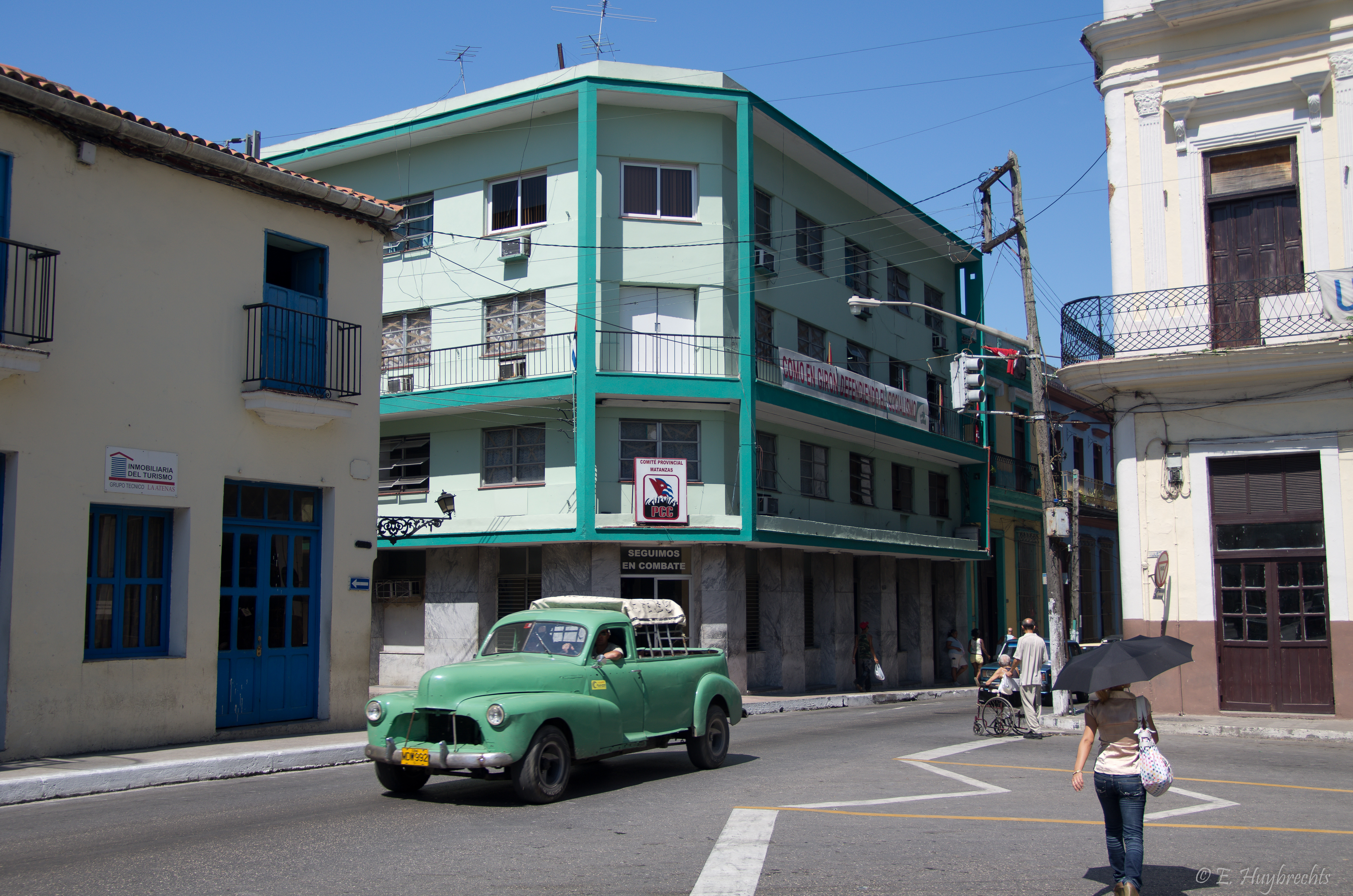
Communist Party of Cuba headquarters in Matanzas. Photo: Wikimedia Commons (CC BY-SA)

The iconic Che Guevara mural on the Ministry of the Interior, Plaza de la Revolución, Havana. Photo: Wikimedia Commons (CC BY-SA)
History of the PCC
VIII Party Congress. Raúl Castro steps down as General Secretary and Miguel Díaz-Canel assumes the party's top leadership — the first transfer of power outside the Castro family since 1959.
The VI Congress approves the "Guidelines for Economic and Social Policy of the Party and the Revolution," launching a controlled process of economic reforms that expanded self-employment.
IV Congress. Following the Soviet collapse, the party faces the "Special Period" crisis. Modest reforms are approved and the U.S. dollar is allowed to circulate in parallel.
The I Congress of the PCC, the first in its history. Theses on the Organs of People's Power are approved along with the new 1976 Constitution, which institutionalizes the party's role in the state.
Official founding of the PCC on October 3, unifying the main revolutionary forces. Fidel Castro is designated First Secretary of the Central Committee, a role he would hold until 2011.
Structure and Function
Political Bureau
The top governing body between Central Committee plenums. It makes the country's most important political decisions. Its members are elected by the Central Committee.
Central Committee
Elected at each Congress, it directs party activity between congresses. It oversees the implementation of decisions and guidelines approved at party congresses.
Party Congresses
The PCC's supreme body meets every five years to set political direction and elect governing bodies. Eight congresses have been held to date.
Base Committees
Party structures in workplaces, schools, and communities. They are the most direct link between the party and citizens, responsible for implementing policy at the local level.
Communist Youth
The Union of Young Communists (UJC) is the party's youth organization, integrating young people ages 14–30 and serving as a pipeline for membership in the PCC.
Constitutional Role
Cuba's Constitution enshrines the PCC as the "superior leading force," granting it a unique role in the political system: it directs and oversees the state itself from outside its formal structures.
"The Communist Party of Cuba, whose presence in the country's political life is decisive, remains the axis around which the island's political and social system revolves."